
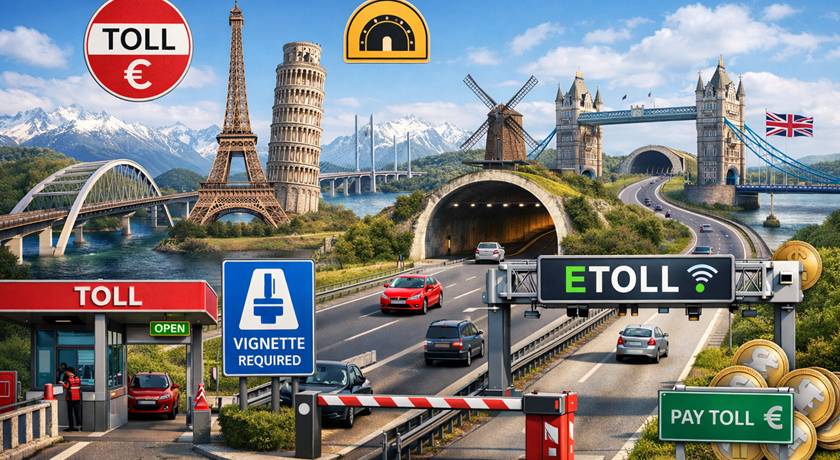
Driving in Europe involves more than just different traffic rules, speed limits, and low-emission zones. In many countries, there is also some form of road charge. Sometimes this means traditional motorway tolls, sometimes vignettes valid for a certain period, and sometimes bridges, tunnels, or local road sections where a fee is charged.
For anyone planning a road trip through Europe, it is therefore wise to check the toll systems well in advance of departure. Charging models can vary greatly between countries, and even within the same country the rules may differ depending on the type of road, vehicle category, or payment method.
How Road Charges Work in Europe
In practice, there are three main types of road charges that passenger car drivers commonly encounter in Europe.
The first is the vignette. This means you buy access to certain motorways or main roads for a specific period, such as a few days, a month, or a year. In several countries this is now digital, which means the charge is linked to the registration number rather than to a sticker on the windscreen.
The second is the traditional toll. In that case, you usually pay for a specific distance, a particular road section, or at toll stations along the motorway. In some countries this is done manually or by card, while in others it is handled more automatically through electronic systems.
The third is local charges, for example for bridges, tunnels, or certain urban access routes. Even in countries without a national toll system, such charges may still apply.
Countries Where Vignettes Are Commonly Used
In several European countries, the vignette is a common way of charging road fees for passenger cars. This applies, for example, to Austria, Bulgaria, the Czech Republic, Romania, Slovakia, Slovenia, Switzerland, and Hungary. In several summaries, Moldova is also mentioned among the countries where vignettes are used.
For travellers, this means there is not always a toll station along the road. Instead, the fee often needs to be arranged before or when you start using the tolled road network. It is therefore wise to find out both the period of validity and which roads are actually covered.
Countries Where Traditional Tolls Are Common
In other countries, it is more common to pay for specific motorways or road sections as you drive. France, Italy, Spain, Portugal, Croatia, Greece, Poland, Serbia, North Macedonia, and Turkey are often mentioned among the countries with traditional tolls or toll stations. Albania, Bosnia and Herzegovina, and Ireland also appear in such overviews.
For drivers, this means in practice that the cost is often influenced by how far you drive, which road sections you choose, and sometimes also how you pay. In some places, cash is still accepted, while other systems are more digital or linked to registration numbers and cameras.
Countries Where Charges Mainly Involve Bridges, Tunnels, or Local Fees
There are also countries where ordinary passenger cars do not encounter a national toll system, but may still need to pay in certain places. Denmark is often associated with bridge tolls, Sweden with bridge tolls and congestion charges in certain cities, Norway with many automatic toll sections, and the Netherlands and Iceland are often mentioned as examples of countries where more limited charges may apply. The United Kingdom is also often described as a country where certain bridges, tunnels, and specific road sections are subject to charges.
For anyone planning a driving holiday, this is important, because a country may be perceived as largely toll-free while still involving costs on certain routes. This applies especially if the trip includes major bridges, tunnels, or access to certain urban areas.
Countries Where Passenger Cars Often Drive Without a National Road Charge
There are also several European countries where passenger cars can, in practice, often use most of the road network without a national toll or vignette. In various overviews, Germany, Finland, Estonia, Latvia, Lithuania, Luxembourg, Belgium, and Ukraine are mentioned as countries where passenger cars are generally not subject to any broad national charging system for motorways. Germany is often highlighted as a clear example of a country where cars under 3.5 tonnes use the motorways without a standard motorway charge.
This does not, however, mean that costs never arise. Local exceptions, specific bridges, tunnels, or other charges may exist even where there is no national system. It is therefore wise to check the actual route, not just the country in general.
Country Overview for Road Trips in Europe
Below is a general overview of many common road trip destinations in Europe. The purpose is to provide a practical picture of the type of road charge that may apply.
Albania – charges may apply on certain road sections.
Andorra – local charges may apply, especially in connection with certain tunnels.
Belgium – in practice, passenger cars can usually drive without a national motorway charge.
Bosnia and Herzegovina – tolls apply on certain road sections.
Bulgaria – a vignette is used for parts of the road network.
Cyprus – is generally described as toll-free for passenger cars at the national level.
Denmark – national motorway tolls are not the main model, but bridge tolls are important for many travellers.
Estonia – passenger cars are generally not subject to a national road charge.
Finland – a national road charge for passenger cars is normally not relevant.
France – traditional tolls are common on major motorways.
Greece – tolls apply on major road corridors.
Ireland – tolled road sections exist.
Iceland – certain local charges may apply.
Italy – tolls are common on motorways.
Croatia – tolls are used on important motorways.
Latvia – passenger cars are generally toll-free at the national level.
Lithuania – a national charge for passenger cars is generally not central.
Luxembourg – is usually described as toll-free for passenger cars.
Moldova – a vignette appears in several overviews.
Montenegro – local charges may apply on certain sections.
The Netherlands – generally no broad national toll for passenger cars, but certain special charges may apply.
North Macedonia – tolls apply.
Norway – many routes are subject to automatic charges, bridge tolls, and urban access fees.
Poland – certain motorways and road sections are tolled.
Portugal – tolls are common, often with electronic elements.
Romania – a vignette is used.
Switzerland – the vignette is central to motorway use.
Serbia – tolls apply on major roads.
Slovakia – a vignette is used.
Slovenia – a vignette is used.
Spain – certain motorways are tolled, even if the system is not the same everywhere.
The United Kingdom – local and regional charges may apply, for example on certain bridges, tunnels, and specific road sections.
Sweden – motorways are not generally tolled, but bridge tolls and congestion charges do apply.
The Czech Republic – a vignette is used.
Turkey – tolls are common on important roads and bridges.
Germany – passenger cars can usually use motorways without a national charge, although specific charges may apply at certain individual crossings.
Hungary – a vignette is used.
Austria – a vignette is common, and certain alpine routes may have separate charges.
The Most Important Things to Check Before You Drive
The most important thing is not only to know whether road charges exist, but how they are collected. A journey through several countries can mean encountering several different systems during the same road trip. For example, you may need to buy a vignette in one country, pay at a toll station in the next, and then deal with a bridge or urban access charge further along the route.
It is therefore wise to check the following before departure:
whether the country uses vignettes, toll stations, or local charges
whether payment is made manually, digitally, or via registration number
whether certain bridges, tunnels, or urban access routes have their own charges
whether the charging system differs depending on vehicle type or route choice
Summary
There is no single model for road charges in Europe. Some countries use vignettes, others charge per road section, and some mainly have local charges for bridges, tunnels, or urban access routes. For anyone planning a longer road trip, it is therefore wise to review the route in advance and not assume that the same payment model applies everywhere.