
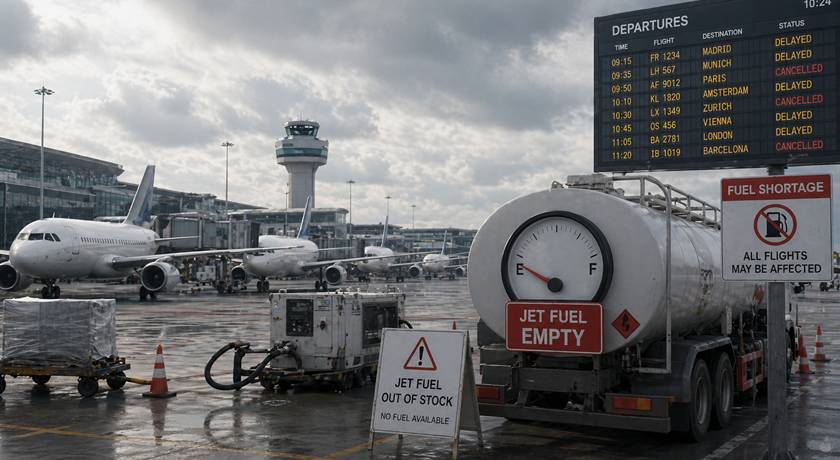
Summer is usually peak season for flying across Europe. But with uncertainty around jet fuel supplies, rising fuel costs and pressure on transport chains, many travellers may start looking for a more flexible alternative: the car.
Reuters has reported that Europe’s jet fuel imports from the Middle East stopped in April 2026, raising concerns about tighter supply ahead of the summer travel period. Europe consumes more jet fuel and kerosene than it produces, which makes imports an important part of the supply chain. Sweden has also issued an early warning about a possible jet fuel shortage, while noting that there is currently no similar threat to petrol or diesel supplies.
This does not mean that every flight will be cancelled. But it does mean that some travellers may want a stronger backup plan. For many families, couples and holidaymakers, that plan is simple: driving through Europe.
Road Trips May Become More Attractive
Driving across Europe gives travellers control. You can choose your own route, stop when you want, change plans along the way and avoid dependence on airport schedules.
If flight uncertainty continues into the summer, road trips through countries such as Denmark, Germany, France, Italy, Spain, Austria, Croatia or the Balkans may become a more appealing option.
But a European road trip also requires preparation. Different countries can have different rules, and the right documents can make a major difference at border checks, police stops, ferry terminals, insurance situations or after an accident.
Documents You Should Bring When Driving in Europe
Before driving abroad, you should check that your driving licence and vehicle insurance are valid in every country you plan to visit. The EU specifically advises drivers to make sure their licence and car insurance are valid when travelling by car in another EU country.
Here are the key documents to prepare before you leave.
1. Driving Licence
Your driving licence is the basic document you must carry when driving abroad. It should be valid for the entire trip and accepted in the countries on your route.
Within the EU, driving licences issued by EU countries are generally recognised, but you should still check local requirements before departure, especially if you will drive outside the EU or EEA.
2. Passport or National ID Card
A driving licence is not the same as a travel document. EU citizens can travel within the EU, as well as Iceland, Liechtenstein, Norway and Switzerland, with a valid passport or national identity card. The travel document must be valid on the day of travel.
This is important for border controls, ferry journeys, hotel check-ins and any situation where you may need to prove your identity and nationality.
3. Vehicle Registration Certificate
The vehicle registration certificate helps show official information about the car. It may be needed during checks, insurance cases, ferry crossings or if the vehicle is involved in an incident abroad.
The Swedish Traffic Insurance Association advises drivers travelling abroad to bring both the vehicle’s insurance policy and registration certificate, noting that this is compulsory in some countries and that requirements can differ significantly between countries.
4. Green Card or Proof of Insurance
The Green Card is an international motor insurance certificate. It helps prove that the vehicle has valid motor third-party liability insurance when travelling across borders.
The Green Card system covers almost all European countries and some countries bordering Europe, allowing vehicles to travel across borders without buying separate motor liability insurance in affiliated countries. However, requirements vary. For example, UK guidance says a Green Card is not needed in many European countries, including the EU, but may still be required in some countries such as Albania, Moldova, Turkey and Ukraine.
The safest approach is to contact your insurer before departure and confirm what proof of insurance you need for every country on your route.
5. AMVI Card if the Vehicle Is Not Yours
If you are driving a vehicle that is not registered in your own name, you may need to prove that you have permission to use it abroad. This can apply to a borrowed car, a family member’s car, a company car or a leased vehicle.
An AMVI Card stands for Authorisation for a Third Party to Use a Motor Vehicle Internationally. It provides written confirmation that the vehicle owner has authorised the international journey and use of the vehicle.
This can be useful if border officials, police, customs authorities, ferry operators or other officials ask you to prove that you are entitled to use the vehicle abroad.
In simple terms: if the car is not registered to you, do not rely on a verbal agreement. Bring clear written authorisation.
6. International Driving Permit
An international driving permit may be needed if your route takes you outside the EU or EEA. It is not a replacement for your normal driving licence. Instead, it works as a translated supporting document.
Rules vary by country, and the EU notes that international driving permits are not regulated at EU level and may not be recognised in all EU countries. If you plan to drive beyond the usual EU road trip routes, check the requirements before you travel.
A Practical Road Trip Checklist
Before you leave, make sure you have:
- valid driving licence
- passport or national ID card
- vehicle registration certificate
- proof of insurance and, if required, Green Card
- AMVI Card if the vehicle is not registered in your name
- international driving permit if your route requires it
It is also wise to keep digital copies of your documents, but do not rely only on digital versions. Original documents may still be needed during checks.
Conclusion: When Flying Feels Uncertain, Driving Offers Control
Europe’s jet fuel problem may encourage more travellers to consider the car this summer. Driving gives flexibility, independence and the freedom to change your route as you go.
But a successful European road trip starts before you reach the motorway. It starts with the right documents.
Before you travel, check your driving licence, passport or ID card, vehicle registration certificate, insurance documents, Green Card, AMVI Card and any international driving permit requirements. With the paperwork in order, you can focus on the best part of the journey: the road ahead.